
NEWS FROM THE FIELD
JUNE 2026
Keeping Soybean Pods on the Plant:
A soybean plant will readily abort a flower that isn’t properly fertilized. It will drop pods or fruits damaged by insects, hail, wind, or disease so they can redirect energy to healthier ones. It prefers to concentrate its limited resources on flowers that have a higher chance of success. Soybean plants constantly adjust their fruit and pod load to match the resources available (water, nutrients, and energy), ensuring the surviving pods receive enough nutrition for strong seed development and survival.
To obtain the highest possible yield from every acre, we must give the soybean plant everything it needs, especially during the critical flowering period, so it can set and retain far more pods than it would under stress.
Soybean Pod Set: Understanding the Factors That Limit Yield Potential
Soybeans have an impressive reproductive capacity, often producing many more flowers than they can carry to maturity. In typical field conditions, plants abort 50–70% of their flowers and young pods. This built-in “survival strategy” helps the crop endure tough conditions, but it also makes pod number per acre one of the most important, and most vulnerable, yield components. Preventing early stress and supporting the plant during the key reproductive stages (R1 through R5) consistently delivers the highest returns.
Critical Timing: The Reproductive Window
Pod set and retention are most sensitive from beginning bloom (R1) through beginning seed (R5). During this window, the plant is rapidly developing flowers, setting pods, and starting to fill early seeds. Stress at this time directly reduces pod numbers.
Primary Factors Affecting Pod Set and Retention
1. Environmental stress
Drought can dramatically affect flower fertilization and pod formation dramatically. Limited water reduces photosynthesis and cuts off the sugar supply to developing flowers and pods, triggering abortion, especially of younger ones.
2. Nutrient Availability and Uptake
Deficiencies in potassium, phosphorus, boron, and calcium can lead to poor flower development, weak pod walls, and higher abortion rates.
3. Pests and Diseases
Insects feed on developing pods and seeds, causing abortion, flat pods, or shriveled seeds. Foliar diseases and root problems reduce overall plant vigor and photosynthetic capacity, leaving fewer resources available for pod retention.
4. Management and Plant Architecture
- Plant density and canopy closure: Overly dense stands can limit light penetration to lower nodes, leading to early leaf senescence and fewer pods in the lower canopy.
- Overall plant health: A robust root system and healthy foliage improve nutrient and water uptake while supporting strong photosynthesis.
Supporting Pod Set with Targeted Nutrition and Biostimulants
Modern agronomic tools can help reduce these stresses and improve pod retention. Foliar applications of biostimulants and targeted nutrients applied from early flowering onward have shown the ability to improve yield when the crop needs support most.
QLF’s L-CBF BOOST™
L-CBF BOOST™ is a liquid carbon-based fertilizer (L-CBF) built on high-quality sugar cane molasses. It delivers readily available carbon energy (approximately 30% sugars) along with micronutrients already present in molasses.
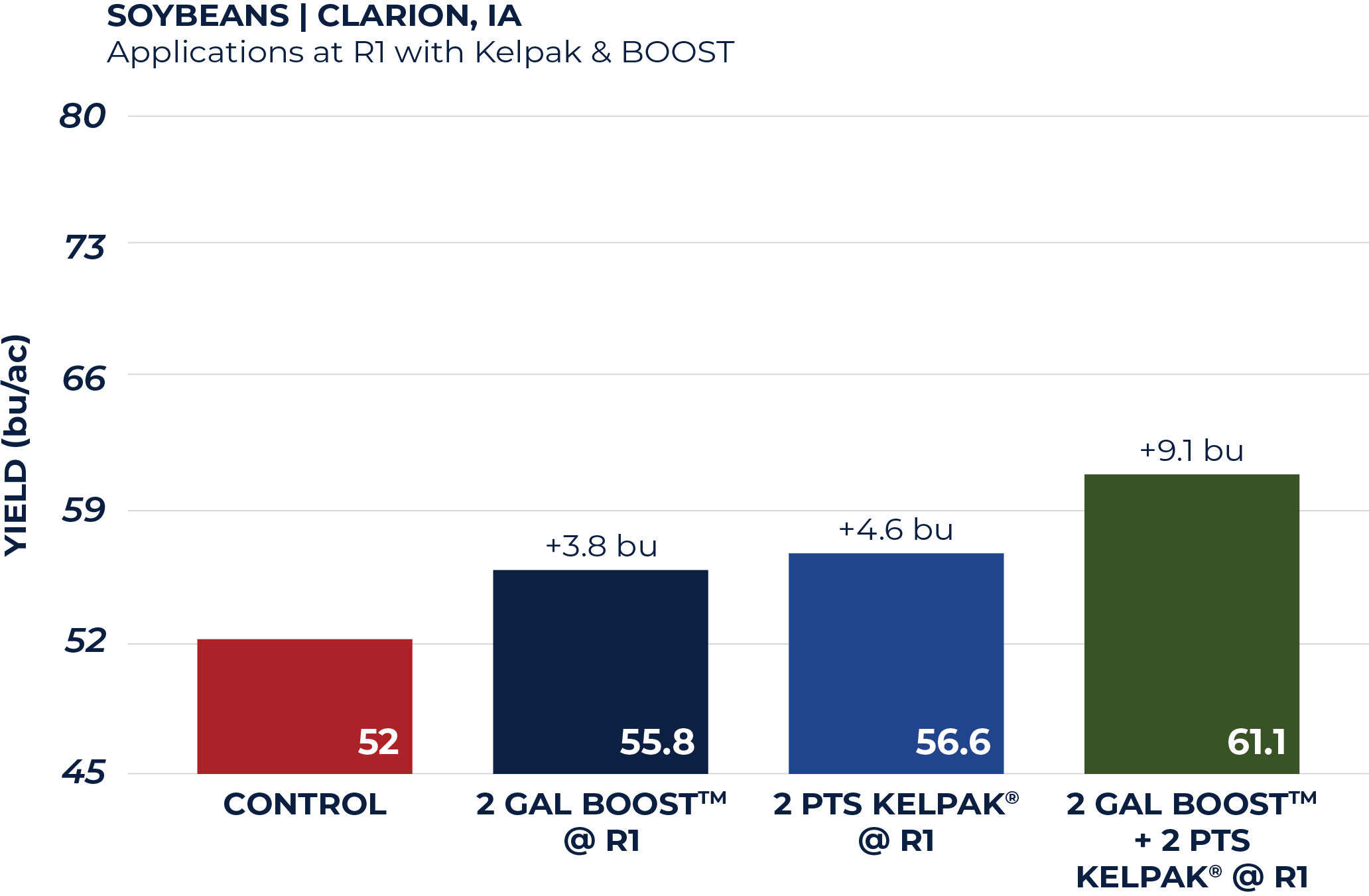
During the critical early reproductive stages (R1–R3), soybeans have an enormous demand for energy to support flowering, pollination, and pod set. BOOST™ applied at 1–2 gal/ac supplies sugar and micronutrients from sugarcane molasses to support these processes. This extra energy helps maintain photosynthesis and sugar transport to developing flowers and pods, especially during periods of drought or heat stress when natural sugar production slows. The carbon and low pH chemistry improve the absorption and translocation of key micronutrients such as boron and calcium, both essential for pollen tube growth, pod wall strength, and successful fertilization.
Kelpak®
Kelpak® is a pure seaweed biostimulant manufactured from the giant brown kelp Ecklonia maxima. It is manufactured using a proprietary cold cell burst technology that employs high pressure differentials to break open the cells and organelles, thereby releasing their cellular content. The released bioactive substances have been shown to promote beneficial soil microorganisms, root growth, and fruit set in various crops. Kelpak® has been proven to improve fruit set and stress tolerance, helping soybeans better withstand challenges during flowering and pod fill. During the critical reproductive stages, Kelpak® supplies natural bioactive compounds, including polyamines, that help plants manage stress. These compounds mitigate the negative effects of drought, heat, and other abiotic stresses while directly supporting successful pollination. The result is better fertilization, fewer flower and pod abortions, and stronger pod retention. Kelpak® can be applied at 2 pts/ac any time from R1 to R3 and can be combined with micronutrients.
NEWS FROM THE FIELD
JUNE 2026
NEWS FROM THE FIELD
JUNE 2026
Stress: The Invisible Yield Robber: Stress is often difficult to see or measure at moderate levels, yet it significantly impacts crop performance and yield. Just like people, crops deal with various stressors every day. Usually, it is not a single factor that causes the most damage, but rather the combination and persistence of multiple stressors. While humans can move to avoid a stressful environment, plants are stationary. However, we do share one vital stress mitigation tool: nutrition. Proper nutrition is essential for creating the molecules that support physiological, biochemical, and structural processes, helping both people and plants stay strong, recover faster, and remain productive.
One stressor that often goes overlooked is herbicide application. Even when a crop is bred to survive an application, the process causes metabolic disruption that requires additional energy and nutrition to manage. During this time, nutrients like manganese and iron often become limiting factors. Root growth and exudates are reduced as the plant diverts its energy toward detoxifying the herbicide instead of building yield.
Plants follow a specific metabolic process to detoxify these chemicals. First, they must convert the herbicide into less toxic molecules by using enzymes to break them down. The second step is conjugation, where the plant chemically modifies the molecules to make them more soluble. By chelating them with sugars and amino acids, the plant can more easily transport the herbicide molecules to storage. Finally, these molecules are deposited into vacuoles—specialized storage vessels that act like a closet to isolate waste—or into the cellulose of cell walls.
This multi-step detoxification process demands significant energy and key nutrients. When resources are diverted away from photosynthesis and toward survival, the result is often a “yellow flash” or yield drag. Essentially, the plant stops capturing sunlight and growing so it can focus on cleaning its internal system.
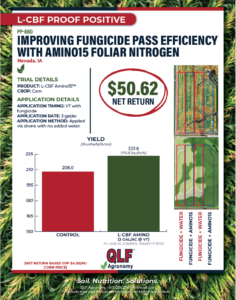
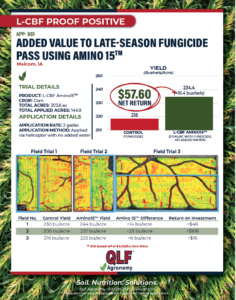
To combat this, QLF conducts annual trials to better understand how molasses-based fertilizers benefit plants and soil biology. We consistently observe that crops treated with L-CBF BOOST as part of a spray program show visibly less stress and higher yields. (View Trial Results HERE) In a recent Beck’s PFR stress mitigation study, BOOST performed exceptionally well, resulting in a 3-bushel increase over the control and a return on investment of over $23 per acre. (View the trial directly from Beck’s HERE) The visual differences are clear: plants treated with BOOST and Flexstar maintain a deeper green color, show less leaf injury, and appear overall healthier.
To build on these field observations, herbicide metabolism is currently being studied at the QLF greenhouse in Dodgeville, Wisconsin. Researchers are measuring exactly how much herbicide a plant absorbs and how quickly it can break it down. Preliminary results indicate better uptake and faster metabolism when BOOST is included in the program. By delivering readily available carbon and nutrition exactly when the plant needs it most, BOOST helps crops handle herbicide stress more efficiently. This management strategy helps farmers avoid yield loss from herbicide exposure and turns potential drag into measurable bushel gains.
NEWS FROM THE FIELD
JULY 2025
We are hearing about sightings of Tar Spot and Goss’ Wilt. The weather has been setting us up for these diseases. The wind currents also indicate the possibility of Southern Rust coming in again this year. Protect and enhance your yields with products from ACN.
NEWS FROM THE FIELD
JANUARY 2025
Crop talk: 2024 was an interesting year in the farming industry. We saw flooding, nutrient leaching, heat, drought, plant diseases such as Goss’Wilt, Tar Spot, and Southern Rust late season. Contact us to learn about QLF Boost as a source of complex carbon to aid in utilization of nutrients essential for plant growth, feeding microbiology and improving healthy and productive soils. NutriBoost Complete for reduced plant stress. Bio Empruv Gen 2.0 to fight GW and Tar Spot, and TuneUp+ for a great seed start.
NEWS FROM THE FIELD
MARCH 2020
Many farmers have commented about the fact that they didn’t get the opportunity last fall to do any deep tilling. The soils are very saturated with moisture. Some soils will be very tight and others have been compacted due to heavy equipment travel on these wet, tight soils. We’d encourage you to check out our product, KRUSTY. This product reduces soil compaction, allowing water and air to move deeper in the soil profile. As a biologically fermented extract, Krusty contains multiple polymers and bio-surfactants that will swell and shrink within the soil, reducing the natural binding effects of compacted soil. Krusty can easily be applied with your in-furrow planting application, or applied with your pre application at a price between $4.25/a (in-furrow) to $8.50/a broad coverage (pre). Much cheaper, and healthier than chemical products or deep tilling.
NEWS FROM THE FIELD
JUNE 2017
Crop talk: With corn spraying nearly completed, many farmers are moving into spraying beans, and thinking about side dressing nitrogen for their corn. Let’s talk about getting the most from side dressing that nitrogen and consider foliar options as we head toward our crops reproduction stage.
Molybdenum 3% is an essential micro nutrient that drives the plant and microbial reactions that fix nitrogen and convert it to amino acids, and eventually proteins. This product is easily, and economically(less than $1/acre) added to the nitrogen side dress application to make the nitrogen feed more plant available, sooner. MORE AVAILABILITY = GREATER PRODUCTION
Foliar MicroBoost is a boost of micro nutrients that should be fed to our crop as it heads toward the reproduction stage in it’s life. This foliar feed helps boost plant health and production with many of the most important micro nutrients needed. One to two bushels/acre makes this product very affordable, because it has the potential to add five to six bushels/acre, giving you a sweet ROI.
Bio Empruv – “Healthy to Harvest” If you have dealt with Goss’ Wilt, you will want to look at this product. If you have seen this nasty disease across the fence from your field, you want to incorporate this products use for your crops protection. Don’t let Goss’ Wilt steal from your production and profits. This product will insure that doesn’t happen.
Ag Natural is designed to boost your crop’s immune system to fight off leaf blight, and strengthen plant health to maturity. Easily applied, we have had farmers report 7 to 17 bushel gains.
Check out these, and other products, available from Advanced Crop & Nutrition. For more information please contact us, we’d be glad to discuss the possibilities available for your operation.
Check out the video about Goss’ Wilt and using the product Bio Empruv.

Bob Streit CCA, CPCS
Bob Streit is a Certified Crop Advisor with experience gained from all over the world. Raised on a farm in northern Iowa, Bob studied plant pathology, pest management and agronomy at Iowa State University. His previous work includes irrigated agriculture with Servi-Tech in western Kansas and 20 years as a Regional Technical Service Agronomist including value added grain projects with Dekalb and Cargil/Mycogen. Now as a private consultant, Bob works with clients in Iowa and surrounding states. He conducts many research plots to test new products and cropping systems.
Bob has also been involved in the USDA Soy Rust Project, including spore trapping in the Midwest. This has led to extensive work in South America, advising agricultural scientists and innovative producers for the last 9 years. He has gained knowledge from traveling to Brazil, Argentina, Uruguay, Paraguay and Chile. Bob publishes articles to magazines and is a weekly contributor to the Ag column for a Fort Dodge, Iowa based newspaper.